
Australian livestock producers can use feed testing to compare grain and forage by nutritional value as feed prices diverge between northern and southern markets. On 19 October 2026, Beef Central reported northern feed barley at $408 per tonne, compared with $300 per tonne in Melbourne.
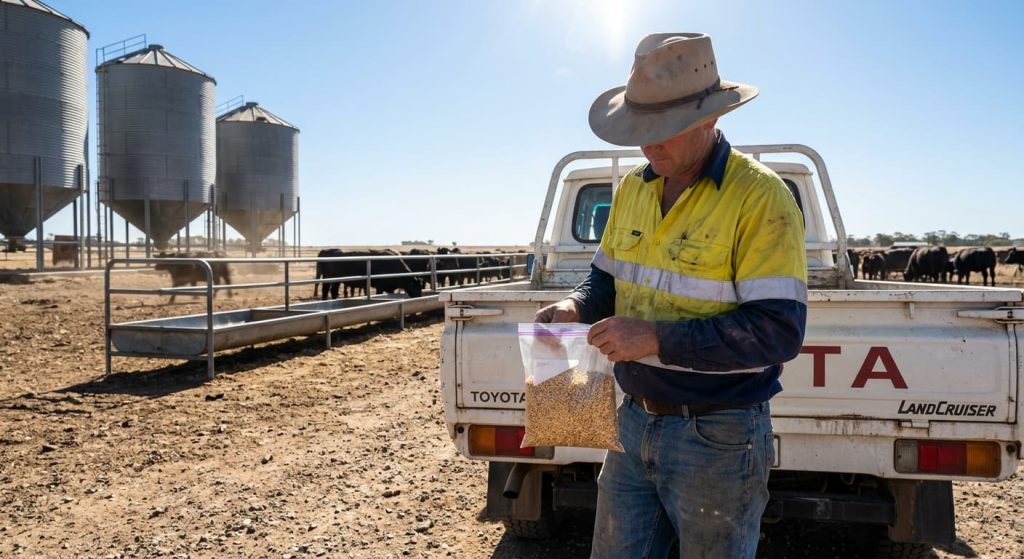
That $108 difference makes it worth checking whether alternative grain supplies offer real savings after freight and nutritional value are considered. Explore the market data and learn how feed analysis can support more informed purchasing and ration decisions.
Key Statistics on Feed Grain Price Split: North vs. South
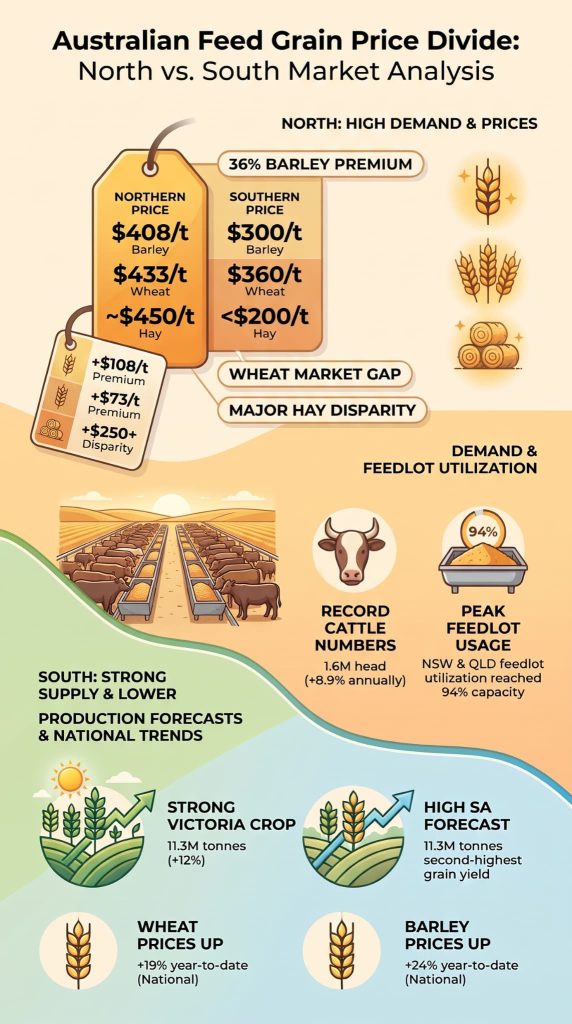
The following 12 statistics show how regional grain prices, crop forecasts, feedlot demand, and rising commodity costs affect Australian livestock producers. Together, they explain why purchase price alone may not show the true cost of feeding livestock.
- $408/tonne – The reported northern feed barley price for the Darling Downs prompt market highlights the cost of sourcing barley in Queensland.
- $300/tonne – The southern Melbourne prompt price provides a lower-priced barley benchmark for comparison.
- $108/tonne (36% premium) – The calculated north-south barley price gap shows how regional sourcing can affect feed budgets before freight.
- $433/tonne – The northern Downs SFW feed wheat price highlights the cost of wheat in the northern market.
- $360/tonne – The southern Melbourne ASW wheat price provides a regional comparison, although the grades differ.
- 11.3 million tonnes (+12% year over year, 28% above the 10-year average) – Victoria’s 2026–27 winter crop forecast points to a strong production outlook.
- 11.3 million tonnes (second highest on record) – South Australia’s forecast indicates potentially substantial grain production, though not all grain will be suitable for feed.
- 1.6 million head (+8.9% year over year) – Australia’s reported record cattle-on-feed number indicates strong demand for feed ingredients.
- 94% – The reported NSW and Queensland feedlot utilisation rate shows that most available capacity was in use.
- +19% – The reported year-to-date increase in national wheat prices points to added pressure on feed budgets.
- +24% – The reported national barley price increase highlights rising costs for barley-based rations.
- Approximately $450/t vs. under $200/t – The reported northern cereal hay and southern pasture hay prices show a substantial regional difference, although the forage types are not directly equivalent.
Why Does Northern Feed Barley Cost $408/Tonne Compared With $300/Tonne in Melbourne?
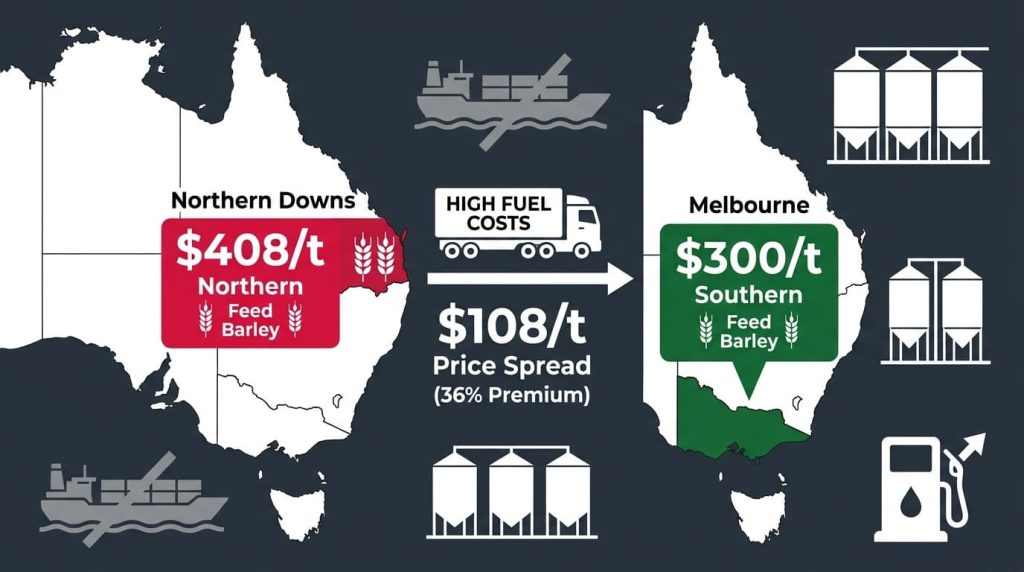
Northern feed barley reached $408 per tonne on the Darling Downs on 19 October 2026, while the Melbourne prompt price fell to $300 per tonne, according to Beef Central’s feedgrain market report.
The difference reflects more than the amount of grain harvested. Beef Central reported that high diesel costs had slowed the movement of Mallee and Riverina barley to southern Queensland feedlots. At the same time, northern growers were holding some grain while feedlots continued seeking supplies.
This creates a challenge for producers who buy large quantities of grain. The cheapest market price may not translate into the lowest delivered cost.
| Market measure | Northern market | Southern market |
| Feed barley prompt price | $408/t | $300/t |
| Price difference | $108/t premium | Baseline |
| Cost for 100 tonnes at quoted price | $40,800 | $30,000 |
| Difference before freight | $10,800 more | Baseline |
What Should Producers Check Before Buying?
Before committing to a large grain purchase, producers should compare the full cost and the nutritional value of each option.
- Compare delivered prices, including freight, handling, and storage.
- Confirm the grade, moisture content, and other supplier specifications.
- Arrange representative feed samples for laboratory analysis.
- Compare metabolisable energy, crude protein, and other relevant nutrients.
- Review the results against the intended ration with a qualified nutritionist.
The key point: A cheaper tonne of grain does not automatically provide cheaper nutrition. Feed testing helps producers assess what each purchase contributes to the ration.
What Does the $108/Tonne Barley Price Spread Mean for Feed Budgets?
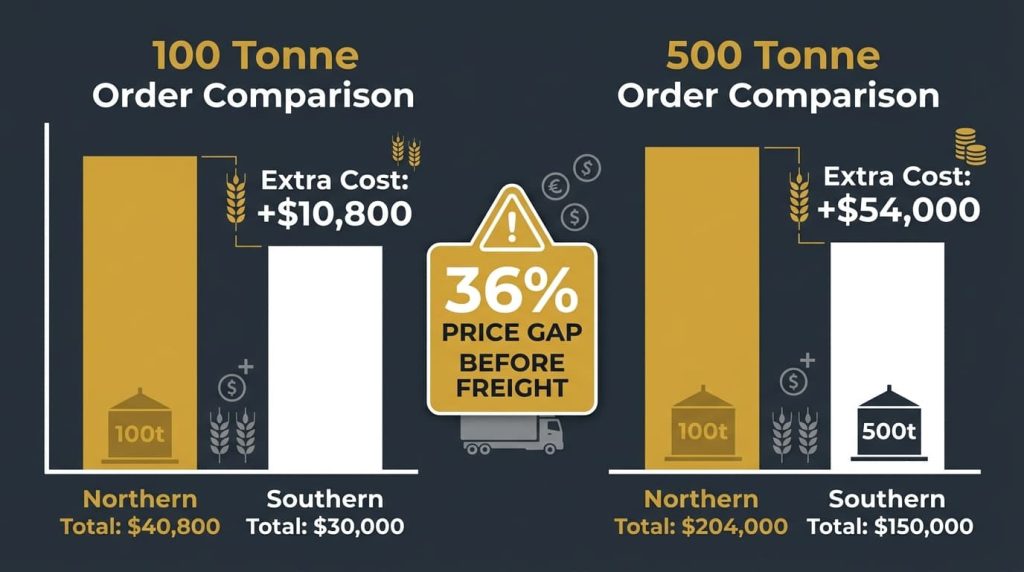
The reported $108 per tonne difference represents a 36% premium for northern barley compared with the Melbourne prompt price on 19 October 2026.
For a business buying 100 tonnes, the difference is $10,800 before transport and other costs. At 500 tonnes, it becomes $54,000. These calculations use the quoted market prices and assume the same quantity is purchased at each price.
However, the comparison does not establish that southern barley would save a northern buyer the full difference. Freight, availability, handling, and grain specifications can change the final result.
How Can Feed Testing Help Producers Compare Value?
Laboratory results can help producers compare ingredients based on their nutritional contribution rather than price alone.
- Compare energy: Estimate the cost per unit of metabolisable energy using suitable laboratory results.
- Check protein: Assess whether each grain sample meets the ration’s protein requirements.
- Review moisture: Compare dry matter content so water is not mistaken for usable feed.
- Evaluate blending: Determine whether a combination of ingredients can meet nutritional requirements at a lower cost.
- Confirm delivered cost: Include freight and handling before calculating potential savings.
For example, if southern barley has a lower quoted price but higher moisture content, its price per tonne of dry matter may be less attractive than it first appears. Differences in energy or protein can also affect the amount of other ingredients required.
Feed testing does not guarantee savings. It gives producers better information for deciding whether a sourcing change is worthwhile.
Why Does Northern Feed Wheat Cost $433/Tonne?
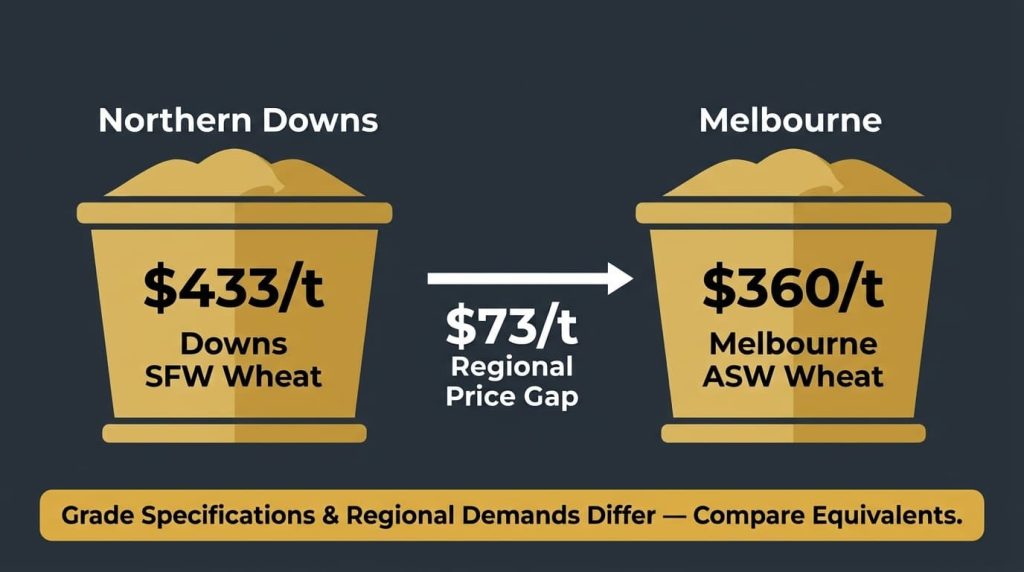
The 19 October 2026 Beef Central report listed northern Downs SFW feed wheat at $433 per tonne, compared with $360 per tonne for Melbourne ASW wheat.
That is a $73-per-tonne difference, but the quoted products have different grade specifications. Buyers should not treat the figures as a direct comparison between identical commodities or delivered prices.
Regional supply conditions also matter. Delays to harvest, transport constraints, local demand, and the availability of suitable grain can affect the prices buyers face.
What Should Wheat Buyers Consider?
Producers and ration formulators should check the following before switching suppliers or regions.
- Confirm the grade and quality specifications of each offer.
- Obtain current quotations that include delivery terms.
- Test representative samples for relevant nutritional characteristics.
- Compare metabolisable energy and protein values.
- Assess whether the grain fits the animals’ dietary requirements.
The decision should account for both grain quality and cost. Wheat’s historical price relationship with barley may not reliably predict which ingredient provides the best value in a changing market.
Why Is Southern Feed Wheat Priced at $360/Tonne?
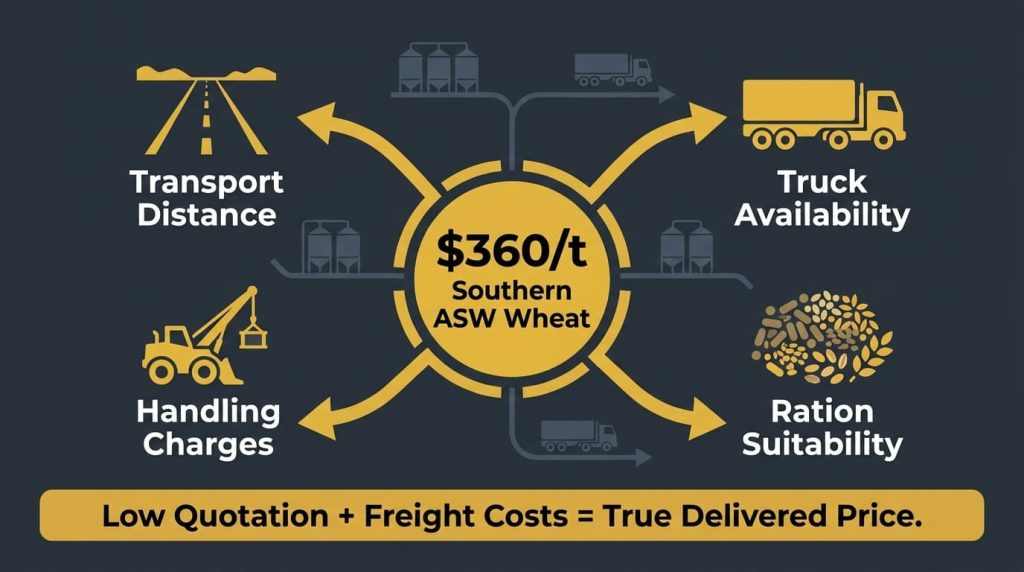
Southern Melbourne ASW wheat was quoted at $360 per tonne on 19 October 2026 in Beef Central’s feedgrain report.
For northern livestock operations, the lower southern quotation may justify investigating alternative supply routes. But a market price is only one part of the calculation. Transport distance, truck availability, handling charges, and the suitability of the grain for the ration all affect the final decision.
How Can Producers Evaluate Southern Wheat?
A practical sourcing assessment should combine commercial and nutritional checks.
- Request current prices and specifications from suppliers.
- Obtain a representative sample before making a large purchase where practical.
- Test moisture, protein, and relevant energy measures.
- Calculate the delivered cost per tonne and per unit of dry matter.
- Ask a nutritionist to assess how the grain would fit the existing ration.
A lower-priced source is useful only if it remains competitive after delivery and supplies the nutrients the animals need. Testing can help producers compare the options using measured data rather than assumptions.
What Does Victoria’s 11.3 Million-Tonne Crop Forecast Mean for Feed Supply?
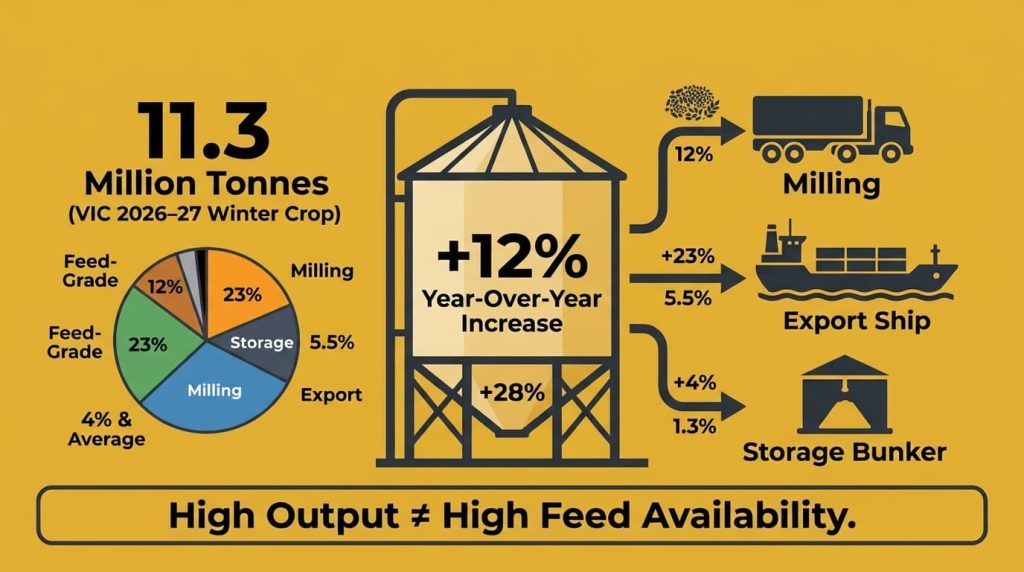
The September 2026 Australian Crop Report from ABARES forecast Victoria’s 2026–27 winter crop at 11.3 million tonnes, up 12% year over year and 28% above the 10-year average, according to the supplied data pack.
Strong southern production may improve the availability of grain for buyers, but total crop output is not the same as the amount available for livestock feed. Grain may be allocated to milling, exports, storage, or other markets, and feed-grade supplies can vary by region.
What Should Buyers Monitor?
Producers should watch several factors as the harvest progresses.
- Actual harvest results compared with early forecasts.
- Availability of feed-grade barley and wheat.
- Local prices and transport costs.
- Moisture, grain quality, and other specifications.
- Changes in demand from domestic livestock operations.
A large harvest can create sourcing opportunities, but buyers should confirm the availability and quality of the grain they intend to purchase. Representative feed samples can help verify whether a particular lot meets the needs of the intended ration.
Why Is South Australia’s 11.3 Million-Tonne Forecast Important?
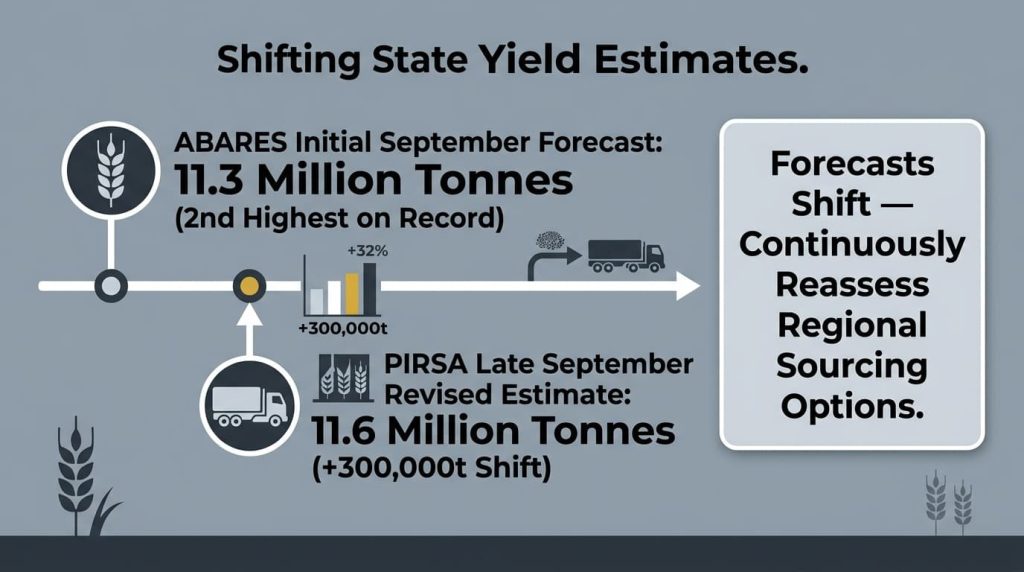
ABARES forecast South Australia’s 2026–27 winter crop at 11.3 million tonnes in its September 2026 report, describing the outlook as the state’s second-highest crop on record at that time. The South Australian Department of Primary Industries and Regions reported the same forecast on 8 September 2026.
The forecast reflected favourable growing conditions and strong crop development. However, it was a forecast, not a final harvest result. PIRSA subsequently raised its own estimate to 11.6 million tonnes in late September, showing how crop projections can change as more information becomes available.
What Does This Mean for Feed Buyers?
A strong southern crop may expand the range of potential suppliers, but it does not guarantee that southern grain will be economical for northern feedlots.
- Compare available feed-grade grain across regions.
- Confirm specifications and quantities directly with suppliers.
- Include freight and handling in the delivered cost.
- Test samples when nutritional variability could affect ration decisions.
- Reassess sourcing options as prices and supply conditions change.
The main opportunity is to evaluate more than one source. Producers should confirm that a potential saving remains after transport and that the grain’s nutritional profile supports the planned ration.
How Does 1.6 Million Cattle on Feed Increase Feed Demand?
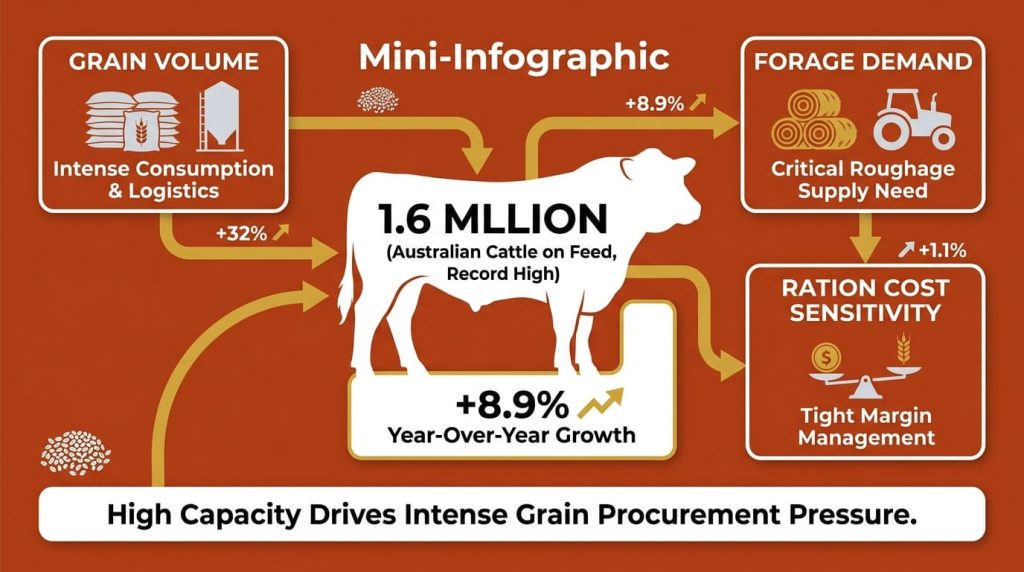
Australian cattle on feed reached a reported record of 1.6 million head in March 2026, up 8.9% year over year, according to the supplied Meat & Livestock Australia (MLA) data cited through the Department of Agriculture, Fisheries and Forestry (DAFF).
More cattle in feedlots can increase demand for grain, forage, and other feed ingredients. Feedlot operators must maintain suitable rations while managing ingredient prices, supply reliability, and animal performance.
When grain prices vary sharply between regions, these decisions become more difficult. A small difference in cost per tonne can have a substantial effect when an operation buys thousands of tonnes over a feeding cycle.
Why Does Feed Analysis Matter When Demand Is High?
Feed testing helps nutritionists understand the nutritional characteristics of incoming grain and evaluate whether it meets the ration’s requirements.
- Check nutritional variability: Test grain from different suppliers or regions rather than assuming the composition is identical.
- Evaluate large purchases: Calculate how differences in energy and protein affect total ration costs.
- Assess grain blending: Verify the nutritional contribution of each ingredient before changing a ration.
- Monitor incoming loads: Use representative sampling and appropriate testing to identify differences between batches.
- Keep records: Compare results across deliveries to support future procurement decisions.
For example, a feedlot sourcing barley from several suppliers may need to adjust the ration when the grain’s nutritional profile changes. Laboratory data helps the nutritionist evaluate those adjustments.
Higher cattle numbers do not, by themselves, explain the north-south price gap. However, strong feed demand can make reliable procurement and feed analysis more important.
What Does the 94% Feedlot Utilisation Rate Mean for NSW and Queensland?
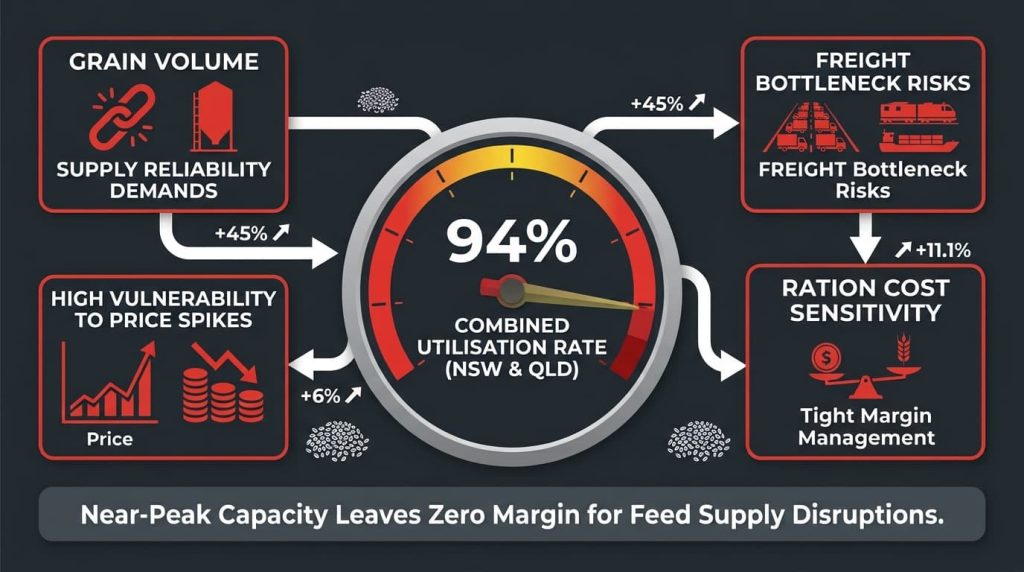
The supplied MLA data reports a combined feedlot utilisation rate of 94% for New South Wales and Queensland in March 2026.
A high utilisation rate means that most available feedlot capacity was in use at the time. Operators need reliable feed supplies to maintain production, so disruptions or sudden price changes can make purchasing decisions more difficult.
Regional supply constraints may also limit the benefits of buying cheaper grain elsewhere. A low-priced offer has little practical value if transport costs erase the saving or delivery cannot meet the feeding schedule.
How Can Feedlots Manage Supply Pressure?
Feedlots can combine purchasing plans with regular feed quality checks.
- Forecast feed requirements against expected cattle numbers.
- Maintain relationships with suitable suppliers across different regions.
- Compare delivered prices rather than market quotations alone.
- Test incoming grain for relevant nutritional specifications.
- Develop contingency plans for changes in price, quality, or availability.
For larger operations, these steps can help nutritionists and procurement teams compare alternatives before committing to a major purchase.
Feed analysis cannot resolve freight constraints or guarantee access to grain. It can, however, help buyers assess whether an alternative ingredient is suitable when local supplies become expensive or difficult to obtain.
Why Has the National Wheat Price Increased by 19% Year to Date?
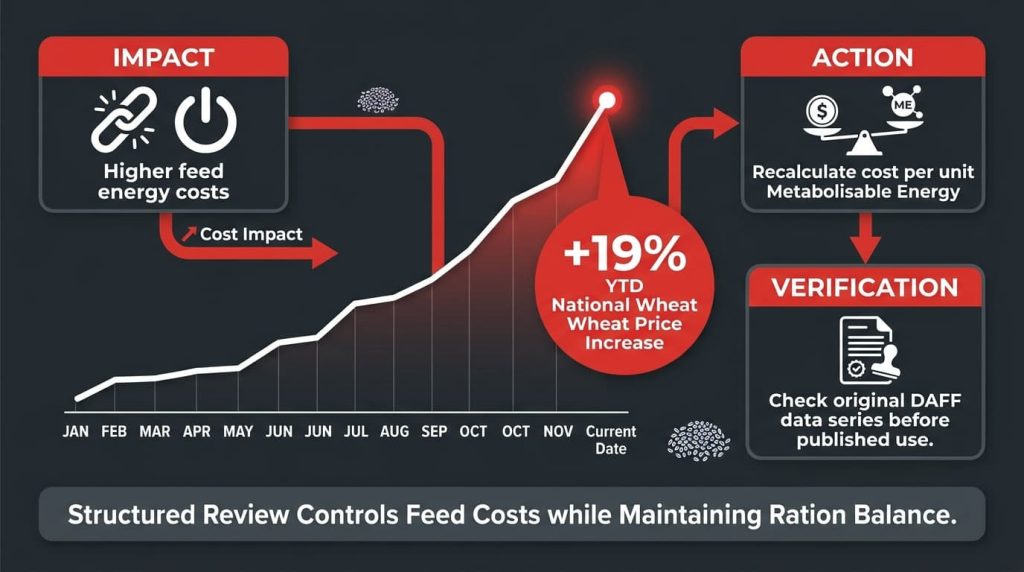
The supplied DAFF data reports a 19% year-to-date increase in national wheat prices in 2026. The exact price series and calculation period should be confirmed against the original government publication before this figure is used in a published article.
Rising wheat prices can increase feed costs for livestock operations that rely on wheat as an energy source. The effect on a particular business depends on its ration, purchase contracts, feed requirements, and the nutritional contribution of each ingredient.
The September 2026 Agricultural Commodities Report from DAFF also discusses the outlook for Australian grain production and commodity prices. Its analysis provides wider context for understanding why producers should monitor both supply conditions and market prices.
What Can Producers Do When Wheat Costs Rise?
A structured review can help identify options without compromising the ration.
- Review supplier quotations and existing contracts.
- Recalculate ration costs when ingredient prices change.
- Test wheat samples when nutritional variability could affect formulation.
- Compare suitable alternatives using cost per unit of metabolisable energy.
- Consult a qualified nutritionist before making major ingredient substitutions.
A cheaper ingredient is not automatically a suitable replacement for wheat. Its energy content, protein contribution, digestibility, and other nutritional characteristics must fit the animals’ needs.
The goal is to control feed costs while maintaining a balanced ration. Feed testing supplies information for that decision, but the results must be interpreted in the context of the complete diet.
Why Has the National Barley Price Increased by 24% Year to Date?
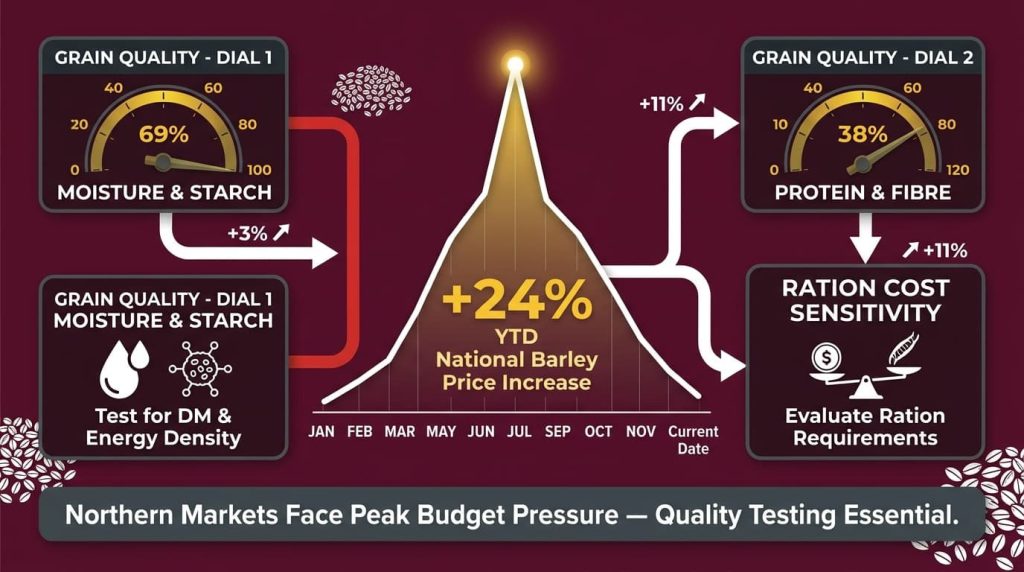
The supplied DAFF statistic reports a 24% year-to-date increase in national barley prices in 2026. Producers who depend on barley may therefore face additional pressure on their feed budgets, particularly in northern markets where the supplied October quotations were already higher than Melbourne prices.
Barley can contribute energy to livestock rations, but its nutritional composition varies between samples. Moisture, starch, protein, fibre, and other characteristics can affect how nutritionists use it in a formulated diet.
When prices rise, producers may consider alternative suppliers, different grain sources, or blends of available ingredients. Each option requires a comparison of both price and nutritional value.
How Can Feed Testing Support Better Purchasing Decisions?
Producers can use laboratory results to compare barley supplies more accurately.
- Measure relevant nutritional characteristics of each sample.
- Check moisture content and calculate the cost per tonne of dry matter.
- Compare energy and protein values between suppliers.
- Evaluate alternative ingredients with a nutritionist.
- Retest when changing suppliers or receiving grain with different characteristics.
For example, two barley deliveries may have similar quoted prices but different nutritional profiles. Those differences can affect how much of each ingredient the ration requires.
Feed testing does not reduce the market price itself. It helps producers understand what they are buying and make better-informed decisions about ingredient selection and ration costs.
Why Does Northern Cereal Hay Cost About $450/Tonne Compared With Under $200/Tonne for Southern Pasture Hay?
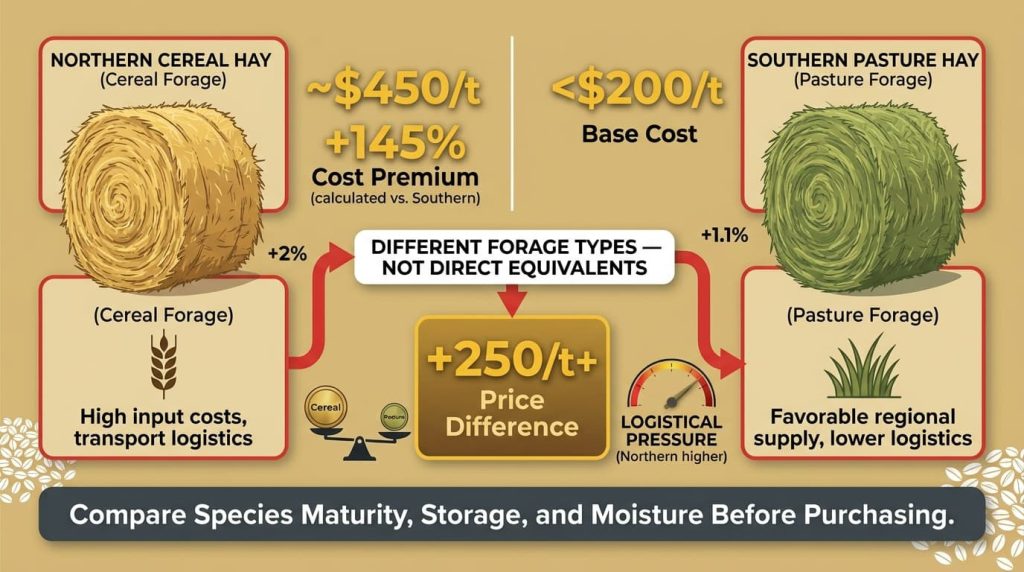
The supplied Tridge data dated 26 October 2026 reports northern cereal hay at approximately $450 per tonne, compared with southern pasture hay at under $200 per tonne.
The reported prices indicate a substantial difference between the two markets. However, cereal hay and pasture hay are different forage types, so their prices cannot be treated as a direct comparison of equivalent products.
Forage quality depends on plant species, maturity at harvest, growing conditions, storage, and moisture content. These factors affect the nutrients available to livestock and the amount of forage required in a ration.
How Should Producers Compare Forage Value?
Laboratory testing can help producers assess the nutritional contribution of hay and other forage sources.
| Comparison factor | Northern cereal hay | Southern pasture hay |
| Reported price | Approximately $450/t | Under $200/t |
| Feed type | Cereal hay | Pasture hay |
| Key consideration | Nutritional value and availability | Nutritional value and availability |
| Useful tests | Dry matter, protein, fibre, and relevant energy measures | Dry matter, protein, fibre, and relevant energy measures |
The most useful tests depend on the forage type and intended use. Producers may consider:
- Dry matter and moisture: Establish how much actual feed material each tonne contains.
- Crude protein: Assess the forage’s protein contribution.
- Neutral detergent fibre (NDF): Evaluate fibre content relevant to intake and ration formulation.
- Acid detergent fibre (ADF): Help assess forage quality and digestibility.
- Energy estimates: Compare available energy using an appropriate laboratory method.
Forage testing is especially useful when the price difference is large or the feeds come from different production systems. A cheaper product may be suitable, but the decision should be based on its measured nutritional value and role in the complete ration.
How Can Feed Testing Help Producers Manage North-South Ration Costs?
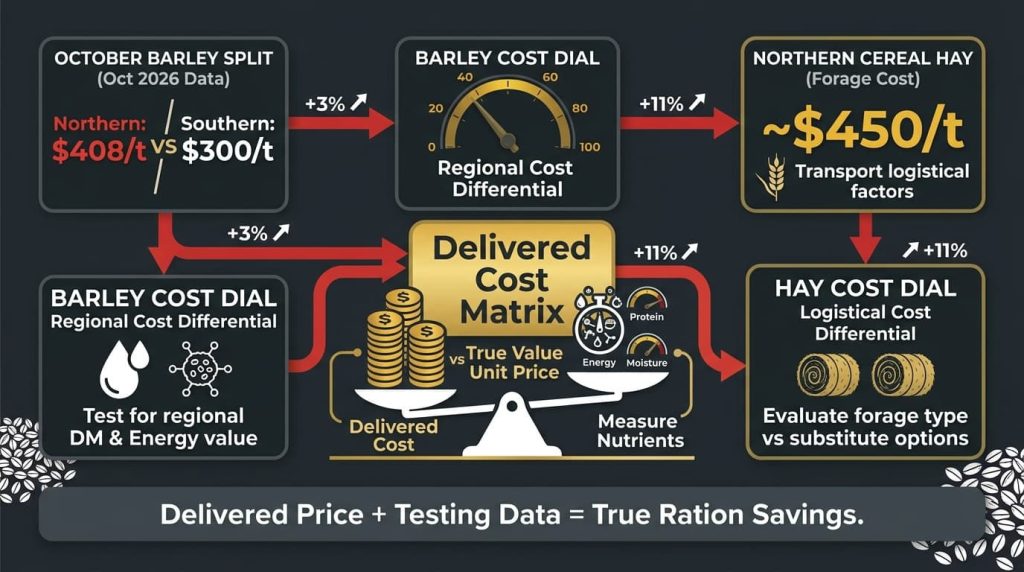
Feed testing helps producers compare grain and forage by nutritional value instead of relying on the purchase price alone. The October 2026 figures show why this approach deserves attention: northern barley was quoted at $408 per tonne, compared with $300 in Melbourne, while northern cereal hay was reported at approximately $450 per tonne.
The actual saving from changing suppliers depends on delivered costs, feed quality, and whether the alternative ingredient meets the animals’ requirements.
Which Testing and Purchasing Steps Matter Most?
A consistent process can help producers compare potential purchases before committing to large volumes.
| Step | Purpose |
| Collect a representative sample | Make sure the sample reflects the feed lot being assessed. |
| Test nutritional characteristics | Measure relevant properties such as moisture, protein, fibre, and energy. |
| Compare delivered prices | Include freight, handling, and storage costs. |
| Calculate cost per unit of nutrition | Compare feeds on a more meaningful basis. |
| Review results with a nutritionist | Confirm that ingredients fit the intended ration. |
| Check subsequent deliveries | Identify variation between batches or suppliers. |
When Should Producers Arrange Feed Testing?
Feed analysis is particularly useful when the decision could materially affect feed budgets or animal nutrition.
- Before committing to a large purchase, where practical.
- When switching suppliers or sourcing grain from another region.
- When blending different grain lots.
- When feed quality appears inconsistent.
- When changing a ration in response to market prices.
- When buying hay or silage with uncertain nutritional characteristics.
Representative sampling is essential. A laboratory result only describes the sample tested. One sample should not automatically be treated as representative of every load from a supplier or every tonne in a shipment.
The results also need to match the decision. For example, moisture and crude protein measurements alone may not provide enough information to compare the energy value of two grain sources.
Testing is most useful when producers select appropriate analyses, interpret the results correctly, and apply them to the actual ration.
FAQ
How Do You Collect a Representative Feed Sample for Accurate Testing?
Accurate feed testing depends on collecting a representative sample. For hay testing, use a hay probe to collect cores from several bales instead of taking loose material from one spot.
Follow the correct forage sample collection or silage sampling procedure for each feed type. Label every sample clearly and follow the laboratory’s instructions for storage, packaging, and submission to reduce sampling errors.
Which Feed Nutrients Should You Test Before Adjusting Livestock Rations?
Feed nutrient analysis should reflect the animals’ nutritional needs and the ingredients in their current ration. Common tests include dry matter, crude protein, crude fiber, and mineral analysis.
For forage, acid detergent fiber (ADF), neutral detergent fiber (NDF), and total digestible nutrients (TDN) help assess feeding value. Use these results to identify nutritional gaps and make informed ration adjustments.
How Can You Check Whether Silage Has Fermented Properly?
Silage testing helps determine whether fermentation has preserved the feed effectively. A fermentation analysis can measure pH, lactic acid, volatile fatty acids, and ammonia nitrogen. These results can reveal poor fermentation or excessive protein breakdown.
Also check the silage for unusual odors, discoloration, heating, and visible mold. Consider the laboratory results and physical condition together before feeding silage to livestock.
When Should Livestock Producers Request Mycotoxin and Feed Safety Testing?
Request mycotoxin testing when feed contains visible mold, has been stored in damp conditions, or comes from crops affected by fungal growth. Depending on the suspected risk, tests may include aflatoxin, deoxynivalenol (DON), zearalenone, and fumonisin analysis.
Feed contaminant screening can identify additional hazards. Use the results to assess potential risks and decide whether the feed is suitable for livestock consumption.
How Can You Choose a Feed Testing Laboratory and Understand the Results?
Choose a feed testing laboratory that offers the analyses your livestock operation requires and explains its testing methods clearly. Check whether the laboratory has relevant accreditation, such as ISO/IEC 17025 accreditation covering the specific tests you need.
Review the feed analysis report and compare the results with your animals’ nutritional requirements. Ask a qualified livestock nutritionist to interpret the findings and recommend ration adjustments when necessary.
What Should Australian Producers Do About the Feed Grain Price Split?
The north-south feed grain price gap shows why the cheapest quoted grain isn’t always the best deal. On 19 October 2026, northern barley was quoted at $408 per tonne, compared with $300 in Melbourne. Freight and feed quality can change the real cost.
Before buying, compare delivered prices and test grain samples to check their nutritional value. Work with a qualified nutritionist before changing livestock rations. Integral Feed Solutions can be a starting point for exploring feed analysis support. Use verified feed data to guide purchasing decisions and manage ration costs.