
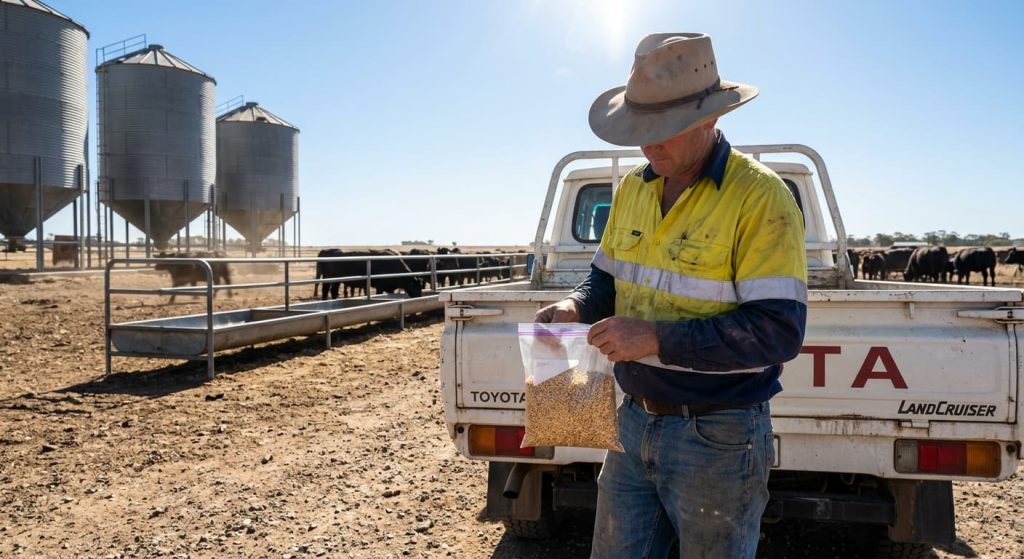
Our analysis of the latest feed grain market data shows a widening split between northern and southern Australian prices that is forcing producers to rethink how they buy grain. On 19 October 2026, northern feed barley was quoted at $408 per tonne on the Darling Downs, while Melbourne prompt barley sat at $300 per tonne. That $108 per tonne difference is more than a market quirk, it is a signal that buying on price alone is no longer enough.
Three Surprising Findings:
1. The price gap is wider than most producers realise. A producer buying 100 tonnes of barley in the north pays $10,800 more than a southern counterpart for the same commodity class. At 500 tonnes, that gap becomes $54,000. Yet the southern harvest is forecast at 11.3 million tonnes in Victoria alone, up 12% year-on-year and 28% above the 10-year average. The spread exists despite abundant southern supply, which means logistics, diesel costs, and regional demand are distorting rational pricing.
2. Record feedlot numbers are colliding with tight northern supply. Australia’s cattle on feed hit a record 1.6 million head in March 2026, up 8.9% year-on-year, with NSW and Queensland feedlot utilisation at 94%. Yet northern grain prices remain elevated because expensive diesel has stemmed the flow of Mallee and Riverina barley to southern Queensland feedlots. Feedlots that test incoming grain precisely can justify blending lower-cost southern grain with local supplies, but only if they know the exact nutritional specifications.
3. Cheaper grain does not mean cheaper feed. Southern barley at $300 per tonne looks attractive against $408 in the north. But price per tonne tells you nothing about metabolisable energy, protein, or moisture content. A higher-moisture southern sample can deliver less usable nutrition per dollar than a drier, more expensive northern load. Without NIR or wet chemistry analysis, producers are making six-figure purchasing decisions on assumptions.
Key Findings:
- Northern feed barley: $408/tonne (Darling Downs prompt, 19 Oct 2026) – Beef Central
- Southern feed barley: $300/tonne (Melbourne prompt, 19 Oct 2026) – Beef Central
- North-South barley spread: $108/tonne (36% premium) – calculated from Beef Central data
- Northern feed wheat: $433/tonne (Downs SFW prompt) – Beef Central
- Southern feed wheat: $360/tonne (Melbourne ASW prompt) – Beef Central
- Victoria winter crop forecast 2026-27: 11.3 million tonnes (+12% YoY, 28% above 10-year average) – ABARES
- South Australia winter crop forecast 2026-27: 11.3 million tonnes (second highest on record) – ABARES/PIRSA
- Australian cattle on feed: 1.6 million head (+8.9% YoY) – MLA via DAFF
- NSW + Qld feedlot utilisation: 94% – MLA
- Year-to-date national wheat price increase: +19% – DAFF
- Year-to-date national barley price increase: +24% – DAFF
- Northern cereal hay vs southern pasture hay: ~$450/t vs under $200/t – Tridge, 26 Oct 2026
What This Means for Australian Livestock Producers:
If you buy grain in northern Australia, the current market is working against you on price. But it is also handing you an opportunity, provided you have the data to act on it.
The commercial case for testing is straightforward. Before committing to a large grain purchase, producers should compare delivered prices including freight, confirm grade and moisture specifications, and arrange representative samples for laboratory analysis. Metabolisable energy, crude protein, and dry matter content should all be measured against the intended ration. A qualified nutritionist can then assess whether a cheaper southern source genuinely delivers savings after freight and nutritional adjustment.
The risk of skipping this step is real. When grain prices vary by 36% between regions, a single poorly informed purchasing decision can cost tens of thousands of dollars in lost performance or wasted feed.
Expert Quote:
“The $108 per tonne spread between northern and southern barley is a market signal, but it’s not a buying instruction. We’ve seen samples from different regions with materially different metabolisable energy and protein profiles at the same quoted price. NIR testing gives producers a nutritional baseline in three working days. Through our partnership with Dairyland Laboratories, Australian producers can access US-calibrated NIR models alongside wet chemistry verification, so they’re not guessing what they’re buying. Test before you buy, not after you’ve formulated a ration on assumptions.”
– Steve Ralston, Integral Feed Solutions, Koondrook, Victoria
Methodology:
This analysis draws on feed grain price quotations published by Beef Central on 19 October 2026, crop production forecasts from the ABARES September 2026 Australian Crop Report, feedlot survey data from Meat & Livestock Australia, and hay market observations from Tridge Insights dated 26 October 2026. North-south price spreads were calculated from the quoted prompt market prices.
Closing
The full analysis, including region-by-region price tables, ration cost scenarios, and a step-by-step guide to comparing grain on nutritional value rather than price alone, is available on our blog.
Read the complete analysis with full methodology on our website here ->
Explore our feed testing services → Integral Feed Solutions Services